I’m very lucky to work in a great district and an even better school. There are so many great things about it — I work with awesome educators that care about the kids; we have high expectations and it is reflected in the school culture; we’re a small, community-based system that’s making positive progress.
However, there’s one area where my district and I are definitely not on the same page, and to me it’s something huge. In my district, Twitter and Facebook are blocked for students AND teachers. As teachers, we are instructed not to post on social media during the hours of the school day. Period. No posting for personal OR professional reasons. What this says to me is: “Social media has no value to you professionally.” Or perhaps: “Even if it does have some value, it’s something you’re going to have to do on your own time.” Obviously, I disagree whole heartedly. I’m pretty sure that everyone that I work with knows that…I’m not typically quiet or reserved about my opinions. But I thought it was time I made my case in writing.
This policy makes it virtually impossible for me to sell Twitter as a PD tool to my coworkers (and I firmly believe that Twitter is the most valuable PD tool out there). Let’s be honest — it’s really hard to show them how to use something when it’s blocked and you’re not allowed to use it during the day.
It’s also really hard to show my students what a strong digital footprint and positive use of social media looks like when it’s all blocked. My kids NEED to see that…so I take screenshots at home, but that can’t demonstrate its true power. This isn’t even touching the opportunities they’re missing out on because of the connections we could be making with other schools, authors, and experts throughout the day using social media…because we DEFINITELY aren’t allowed to have a school or library social media account where we share out the things we’re doing so the community can share in our learning. If I want to use Twitter to line up Skype or Hangout meetings to help my students make global connections, I have to do it after school hours.
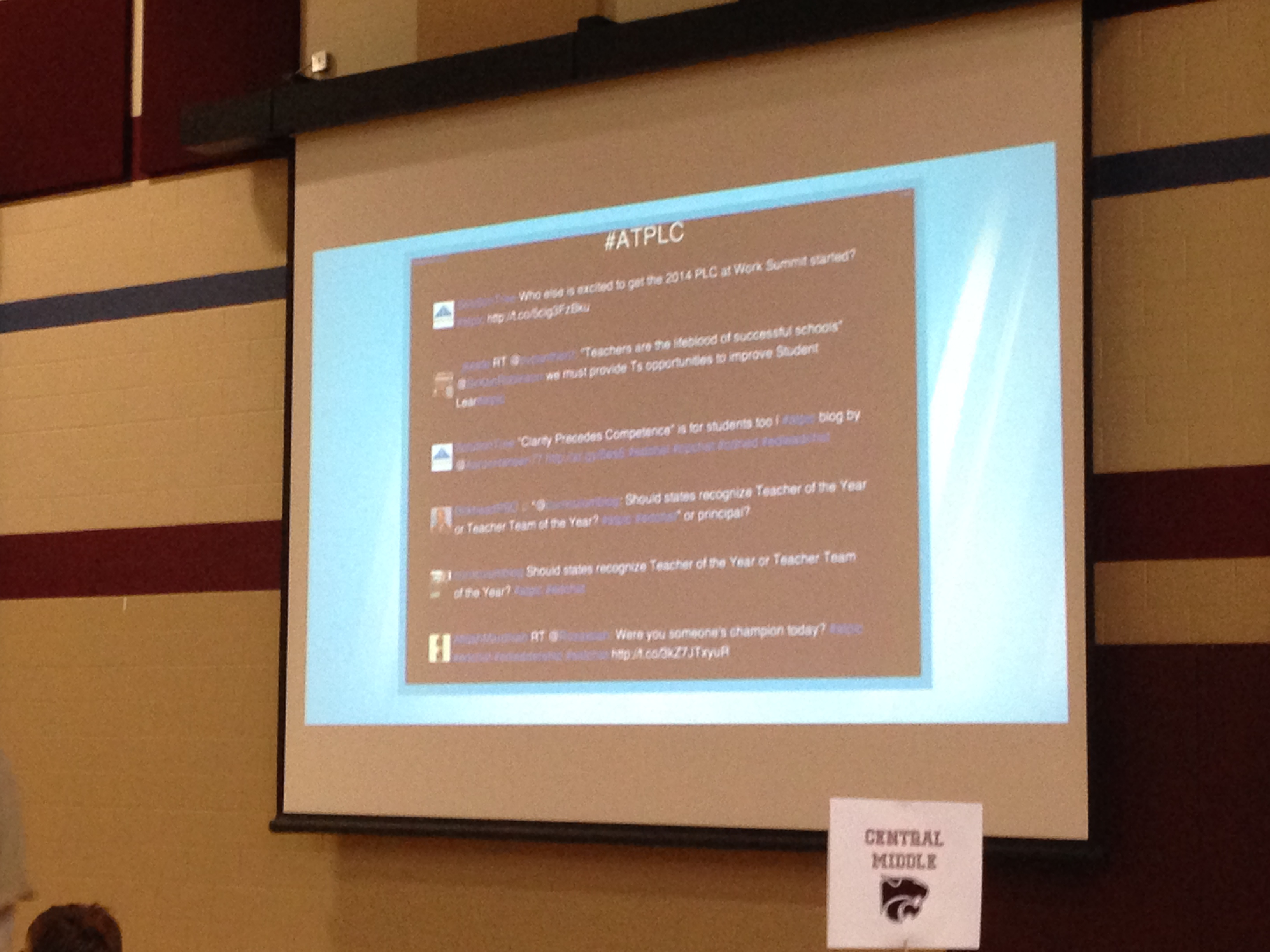
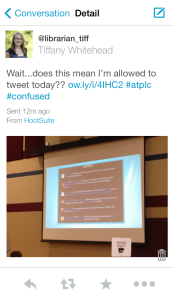
I found my district’s recent professional development days to be very telling of the current stance on technology and social media. Last month, we had two full days of district-wide professional development training on Professional Learning Communities. All of the faculty members from all five schools in our district gathered together to participate in a PLC conference as a satellite location (sessions were streamed in from Arizona). In the days before these PD days, we were instructed that we were NOT to have any technology visible during the sessions (no laptops, iPads, phones, etc.). As someone who attends conferences regularly (okay, maybe excessively/obsessively), I know the power of a backchannel and was very disappointed that I wouldn’t be able to Tweet what I learned along the way. For me, that has become a way that I process my learning at a conference. So despite my extreme frustration and disappointment, I tried to enter these two days of PD with a decent attitude. Imagine my surprise when I arrive the morning of our PD to see a hashtag and Twitter stream up on the big screen.
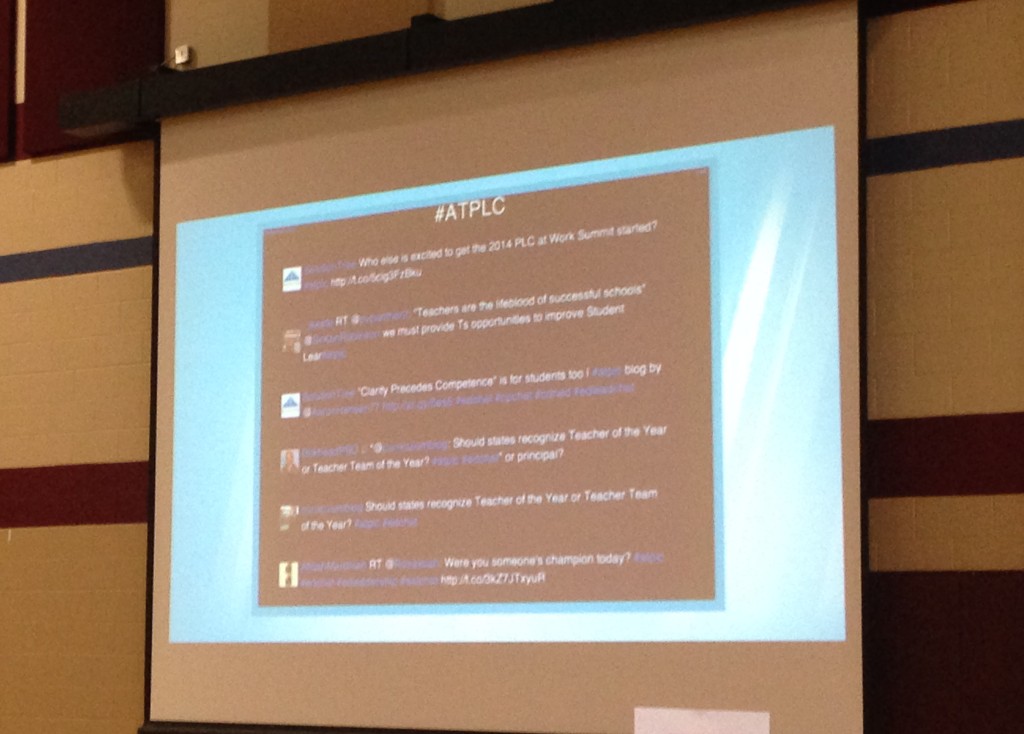
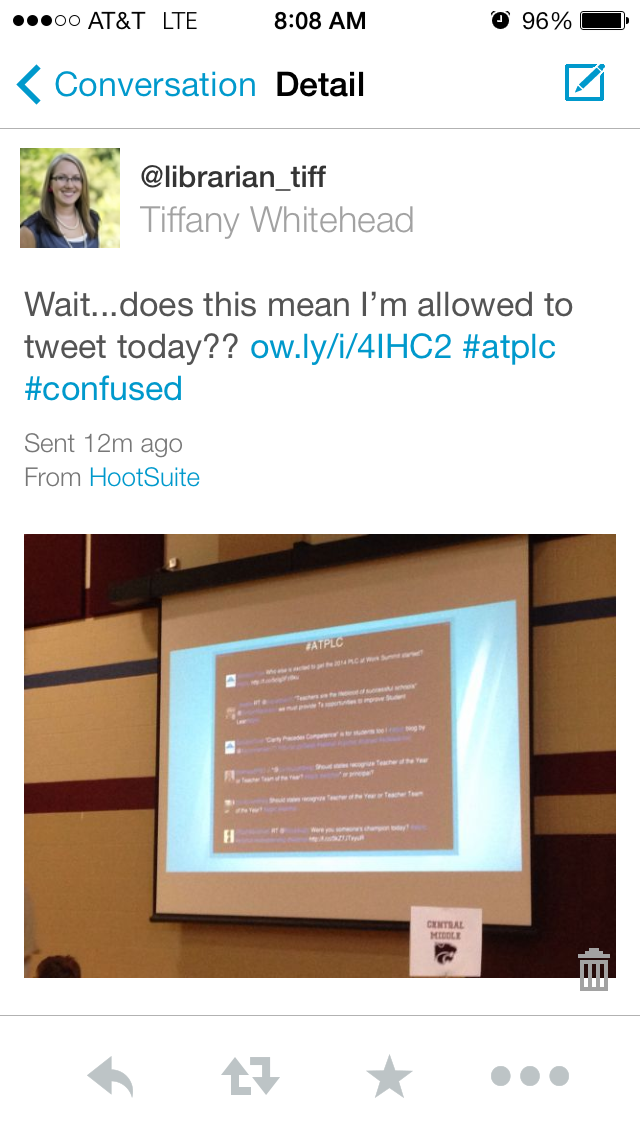
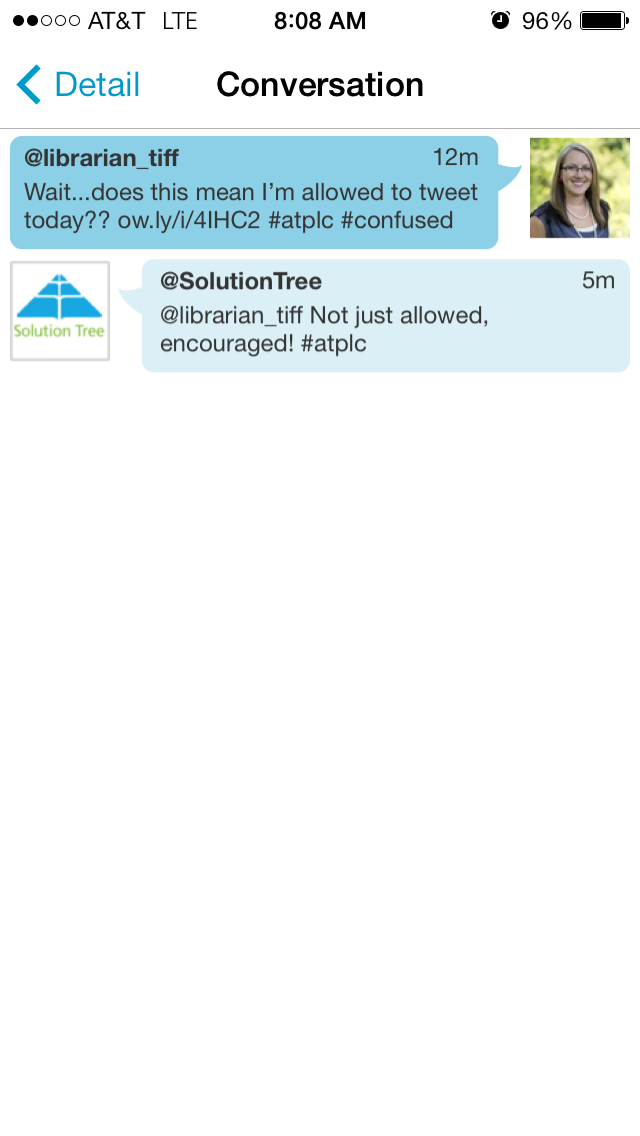
Since it was before our official start time…I went ahead and Tweeted them:
 Â Â Â
   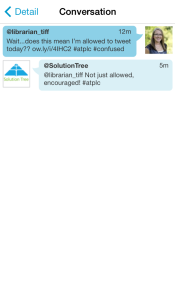
Hm. Not on the same page. I followed the rules…put my phone away during sessions…and in my notes I wrote down the things I would have Tweeted, had it been allowed.
The argument against having technology was that it would be a distraction. For me, it would have been a tool to enhance learning. Do teachers need to learn to use technology the right way in the right situations at the right times? Absolutely. Just like our students need to learn the same thing. But it’s mighty hard to learn it (or teach it) if we can’t use it. I get that they think it’s easier and less of a headache to just block and ban. It’s not as scary, not as threatening. However, we are doing a disservice to our teachers and our students by not allowing them the opportunity to experience a different level of learning. We’re doing a disservice by not requiring them to develop the skills that are essential to be successful in our digital world.
We talk about how wrong it is to issue a blanket punishment for all students because of the actions of a few. What about being punished in advance for something that hasn’t even happened yet?
There is so much good in social media for education. There’s so much positive potential and so many endless possibilities. And if we aren’t taking advantage, then our students are missing out.
I recently shared about our March Madness Book Bracket. We are now down to our Final Four books:
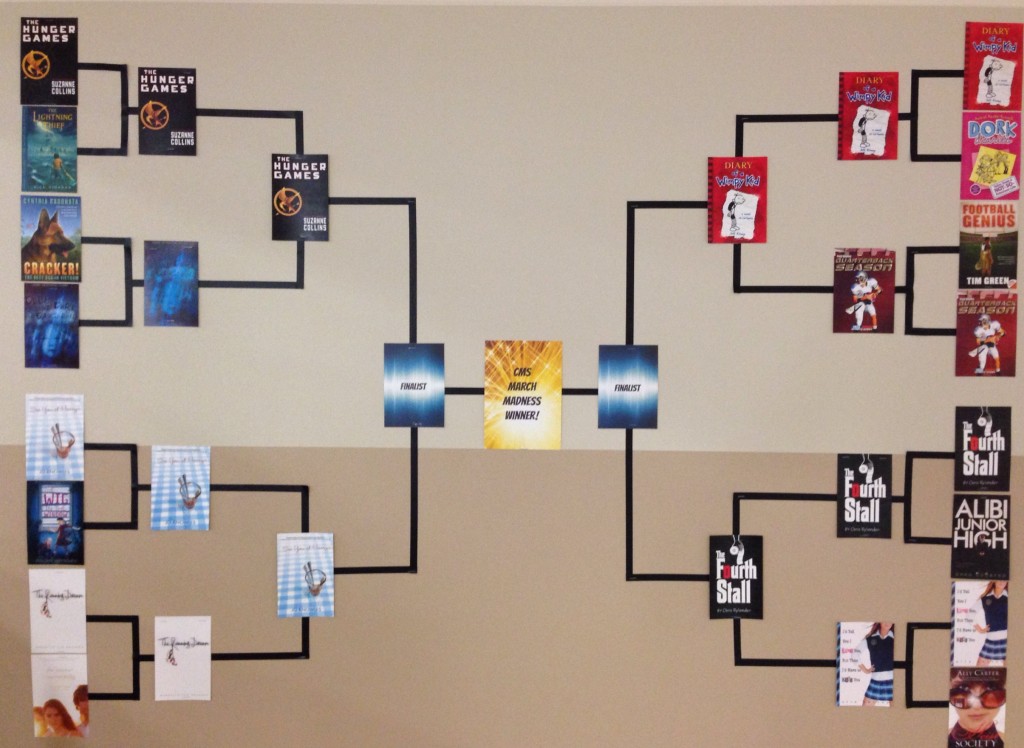
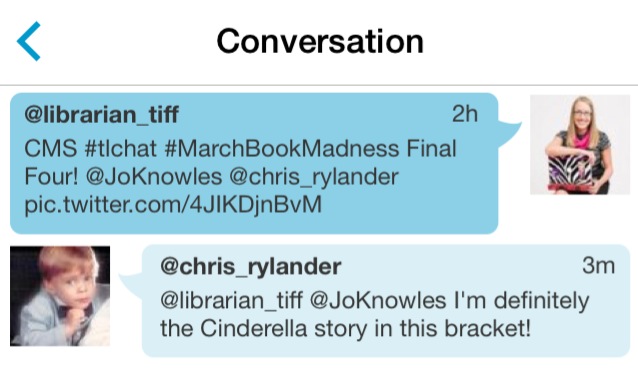
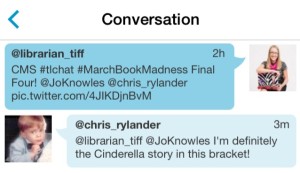
I’m so excited to see favorites See You at Harry’s and The Fourth Stall in the Final Four! I shared this picture on Twitter and tagged authors Jo Knowles and Chris Rylander. Our students LOVE their books. I was really excited when Chris responded to my Tweet:
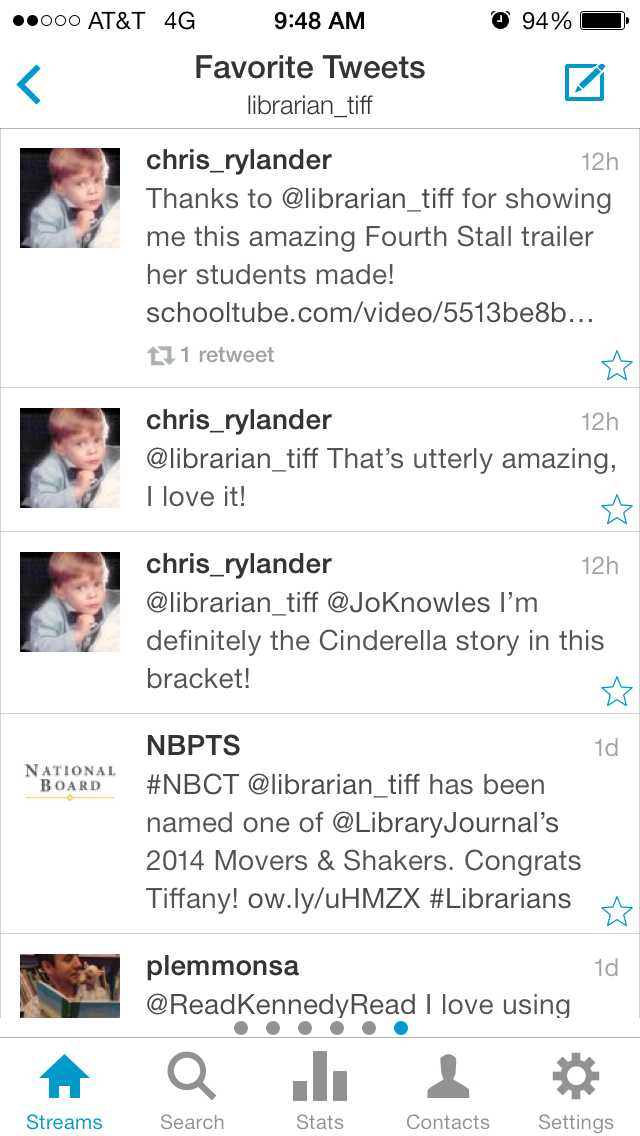
Back in November, my Multimedia students created a book trailer for The Fourth Stall as their entry for a video contest. Although they didn’t win, we were so proud of the final product. Last night, I shared the link to our video with Chris Rylander:
I was so excited when he Tweeted back about the video:
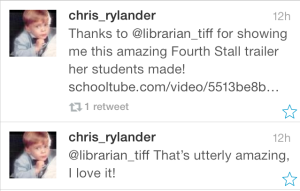
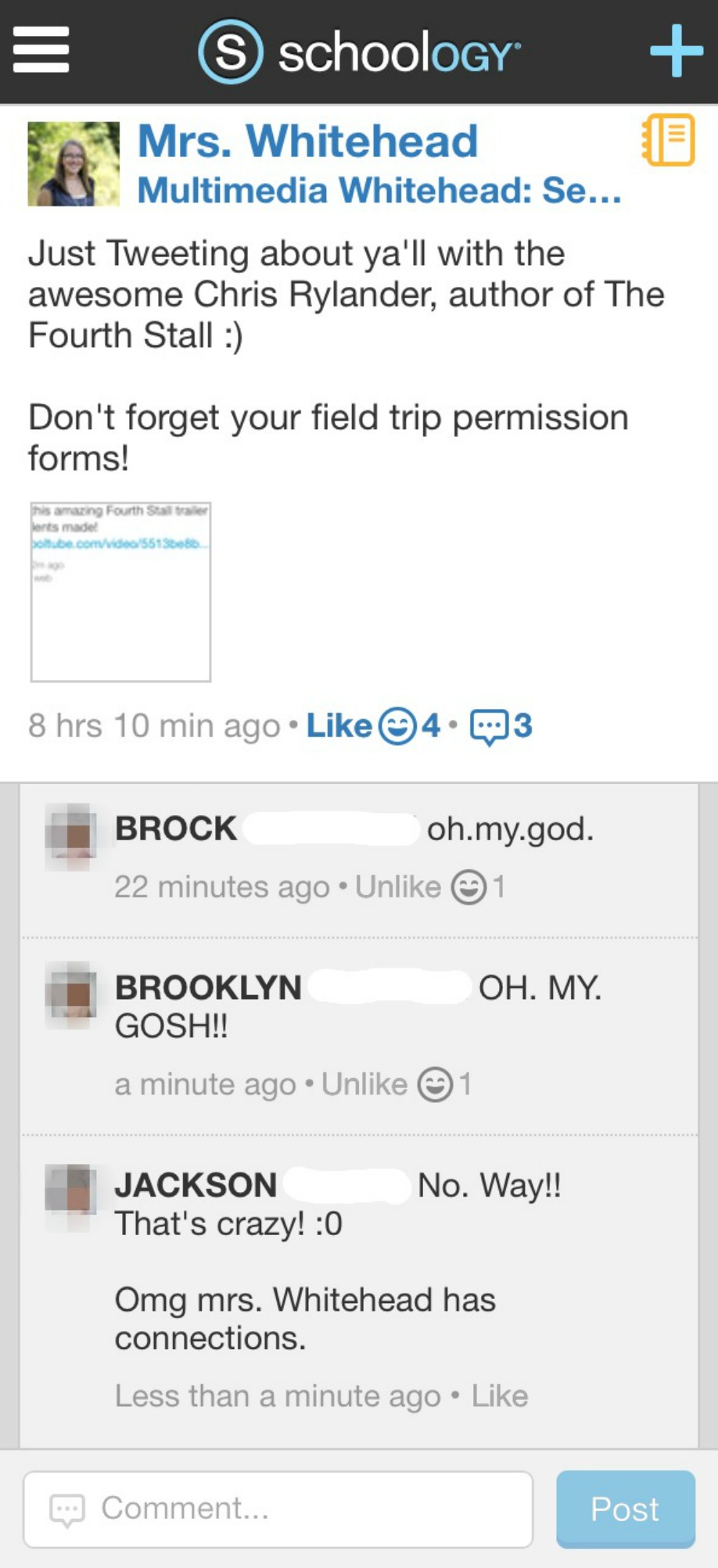
So excited that I had to take a screen shot and post it on Schoology to share with my students. Naturally, they freaked out:
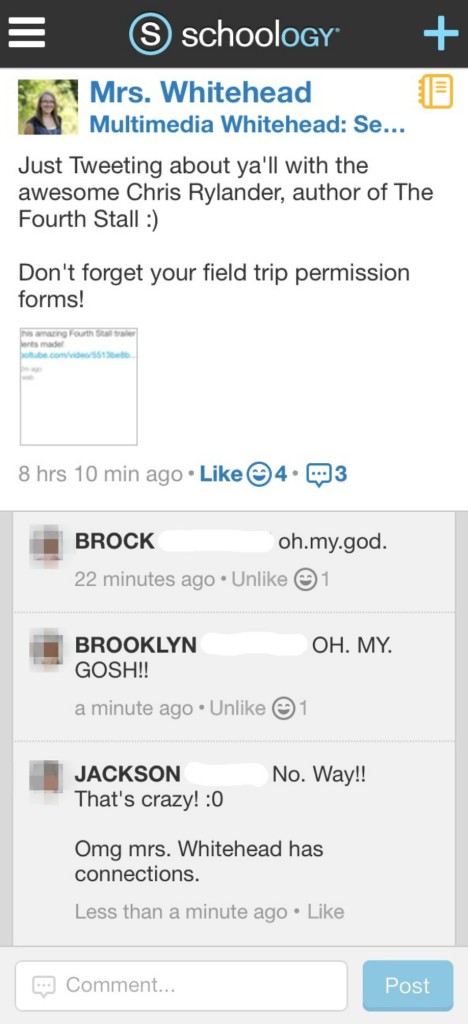
And of course they rushed into the library this morning to geek out some more. They were so excited that the author of The Fourth Stall, one of their FAVORITE books, saw the video they created about his book!
This is just one small example of the power of social media. Connecting our students with others has so much potential to excited, engage, and motivate. Getting our teachers connected will introduce them to ideas, opportunities, and learning that just can’t happen within the walls of the school. This is something I’m passionate about and not willing to let up on because social media changed my path as an educator. I would not be able to provide my students with the opportunities, my teachers with the resources, or myself with the support that I get as a professional without my PLN. When I say that Twitter changed my life, I’m not exaggerating. The opportunities and experiences coming my way would not be possible if I were not a connected educator. And I want to be able to share that with my teachers and students.